
DNREC Certified Biofiltration Soil
Bioinfiltration and bioretention best management practices (BMPs) are stormwater management tools with enormous and cost-effective benefits, according to recent research. Biofiltration is a key component in the low-impact development (LID) approach to managing stormwater. Bioretention facilities are small, landscaped basins intended to provide water quality management by filtering storm water runoff before releasing into storm drain systems.
For orders and estimates contact us here.
Bioretention utilizes soils and both woody and herbaceous plants to remove pollutants from storm water runoff. The soil mix used for bioretention systems is central for determining flow control and water quality treatment performance. To perform properly, the soil must provide the desired infiltration rate, support vegetation and soil biota, and provide water quality treatment.
Specifications for biofiltration soil are outlined by each state. In the state of Delaware, the Delaware Department of Natural Resources and Environmental Control (DNREC), grants certifications to suppliers who have been approved after a testing process. Suppliers seeking approval must demonstrate not only that soil conforms to the proper mixture ratios, but that they have the appropriate equipment to mix the material, proper storage to keep it dry and free of debris. More specifically, the medium must be a uniform mix, free of stones, stumps, roots or other similar objects larger than two inches and filter medium planting soil must be a uniform mix of equal parts by volume of the following: Clean Concrete Sand, Peat Moss, Triple Shredded Hardwood Mulch (Well Aged – Stockpiled – 6 to 12 Month).
Bioretention Supplier Certification
DNREC certified bioretention soil suppliers are listed on the DNREC website: learn more..
In the State of Delaware, bioretention soil may only be supplied from biosoil-certified vendors. Moon Nurseries is a certified vendor for bioretention soil.
In early 2008, Moon Nurseries submitted samples of its bioretention soil mixture (BSM) to a DNREC approved laboratory (Duffield Associates, Consultants in the Geosciences) to obtain certification of its biosoil medium. Laboratory testing was performed on a representative sample of biofiltration soil to evaluate general conformance of the sample provided with DNREC – Soil and Water Conservation Division’s requirements for biofiltration soil.
Laboratory testing consisted of Particle Size Analysis (ASTM D 422) and Hydraulic Conductivity (ASTM D 5856, Constant Head Method) determination on sample provided. The laboratory performed particle size analysis and hydraulic conductivity testing to review the soil sample for the following DNREC requirements: a mix consisting of equal parts by volume of triple-shredded hardwood mulch, peat moss, and clean concrete sand meeting the requirements of AASHTO M-6 or ASTM C-33;
and an infiltration rate of 5 inches per hour.
The laboratory concluded that all Mix Components, Sand Gradation, and Infiltration Rate met or exceeded the DNREC required standards. Moon Nurseries has been a reliable, certified supplier of bioretention soil to the Delaware area ever since.
Contact us with your low-impact development or stormwater management needs and we will be happy to explain how Moon Nurseries can help you effectively and economically reach your goals.
Bioretention Construction
Currently, bioretention constructions are the preferred best management practice for small sites. In highly urbanized areas a greater degree of hydraulic control may be prescribed. To employ the proper bioretention hydraulics, professionals such as engineers, architects, property owners, municipal officials, and contractors may be employed to prepare engineering plans, design and/or review SWM/SWQ systems, conduct water quality inspection and observation, install and maintain bioretention basins, and try to understand the expectations and maintenance of the surface runoff. These individuals will also inspect the operation of the bioretention construction.
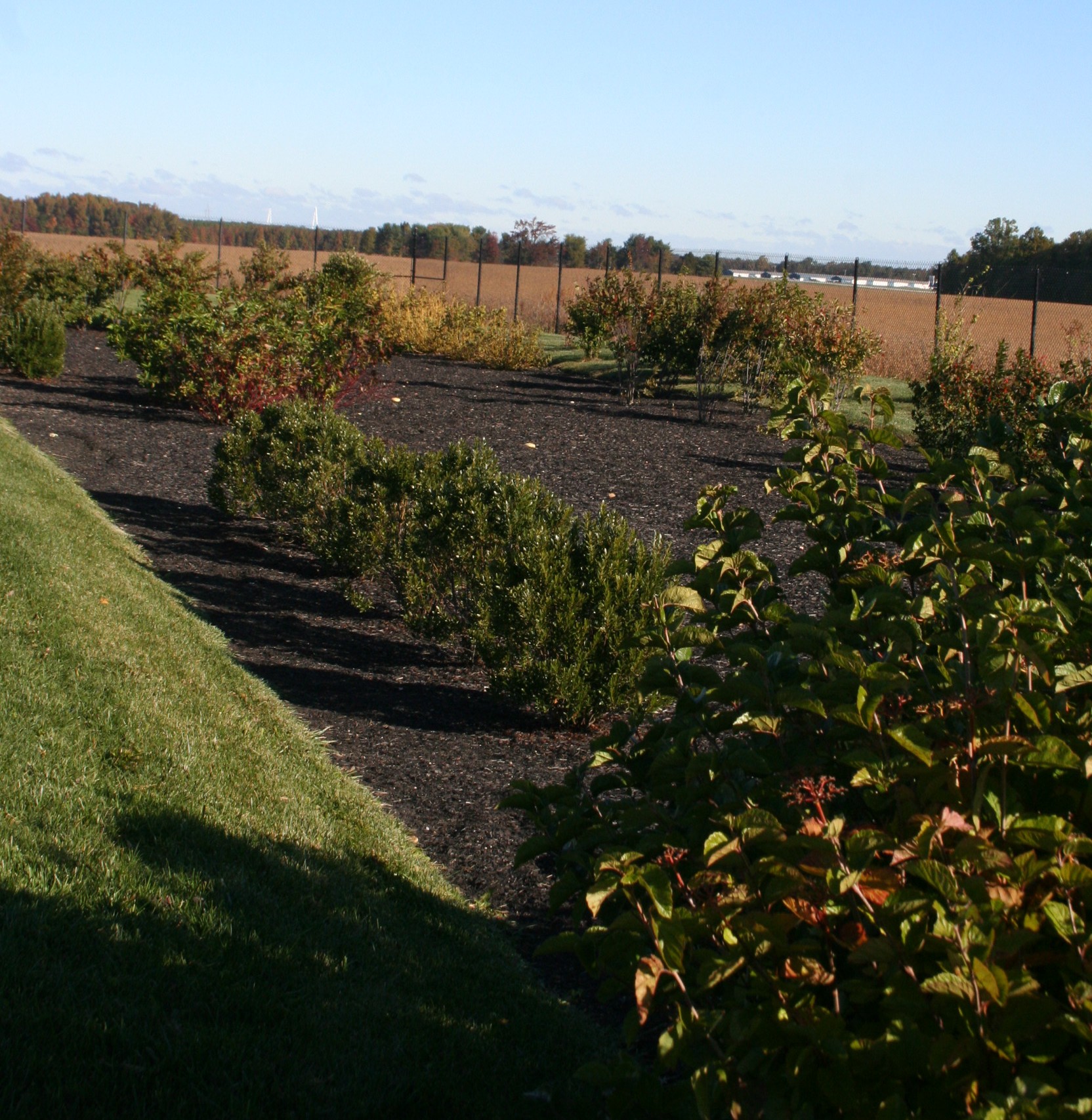
Bioretention Design and Construction
Guidelines for bioretention design and construction can be found at the websites for the EPA, the Department of Natural Resources for each state, or on some of the links listed below. In most cases, these guidelines also specify the planting soil mix, specifying the coefficient of permeability recommended locally as well as the EPA recommended k value. Soil providers should be able to describe the make up of their bioretention soil mix and provide proof of certification. Moon Nurseries is a certified provider of bioretention soil, listed in the DNREC official website and documentation.
Plantings
When constructing Bioretention facilities, in addition to specifying plants that can tolerate saturated conditions, specify plants that add aesthetic value to the property. Ensure plantings are taking and growing, since plant roots provide for much of the pollutant removal. Reports advise that we should consider the bioretention basin is working properly when there is no standing water and plants are healthy and growing.
How it Works: About Biofiltration
What is Biofiltration?
Water biofiltration is the process of improving stormwater quality through the processes of filtration through biologically influenced media. This pollution control technique uses living material to capture and biologically degrade pollutants. Examples of biofiltration include bioswales, slow sand filters, and treatment ponds.
Bioretention removes contaminants as fluid passes through media or a biological system. In water treatment, and stormwater management, bioretention by microbes growing within soil or filter media enhance retention and degradation of contaminants from the water. The capacity to detain contaminants can buffer sudden concentration spikes from occurring in the outflow. Bioretention / bioinfiltration facilities are low-impact design, green measures that reduce the creation of and then employ nature to address the detrimental impacts of urban stormwater. Stormwater biofiltration systems include: bioretention systems, rainwater guards, constructed surface flow wetlands, and constructed sub-surface flow wetlands.
In the past two decades, state and federal regulation has moved from detention strategies of simply storing the water during a major storm event, to natural control measures encompassing both small and larger storms. As noted in Congressional testimony, stormwater management techniques now necessarily include reducing the amount of pavement used, or disconnecting drainpipes so that stormwater runs over the grass, water reuse, and structures that integrate with nature, such as bioretention / bioinfiltration facilities, green roofs, and pervious pavements.
The state of Maryland has been a leader in stormwater management designs, and BMP’s from the state and from Maryland counties like Montgomery have set the norms for many states. Soil mix in bioretention construction is of paramount importance, with many states publishing guidelines of the ideal mixture composition for effective, long-term local biofiltration. Delaware requires all suppliers of biosoil media to register with the state, and publishes this list for professionals involved in planning bioretention construction projects.
Moon Nurseries is a registered supplier with the state of Delaware for bioretention soil mixture. Moon Nurseries also carries a full line of local vegetation for bioretention plantings, including moisture and flood-resistant grasses, shrubs and canopy trees.
For more information, or to order biosoil or bioretention plantings, contact Moon Nurseries at the number below.
Biofiltration Soil Requirements
Weeds – Free of seed and viable plant parts of species in 920.06.02(a)(b)(c) when inspected. Debris – 920.01.05(a)(2) Textural Analysis – Sand 2.0-0.50, Silt 0.050-0.002, Clay less than 0.002 Soil pH – pH of 5.7-7.1 Organic Matter – Minimum 1.5% by weigth Nutrient Analysis and Soluble Sales – Calcium (Ca) 32 ppm, 25 FV, Magnesium (Mg) 15 ppm, 25 FIV, Phosphorus, 18 ppm, 25 FIV: MAX 92 ppm, 100 FIV, Ptassium (K) 22 ppm, 25 FIV, Sulfur (SO4) 25 ppm, Soluble Sales 40 ppm Harmful Material – 920.01.01(a)
Best Plants for Bioretention Planting
Recommended Plants for Bio Retention Planting
- Acer rubrum, Red Maple
- Betula nigra, River Birch
- Fraxinus americana, White Ash
- Fraxinus pennsylvanica, Green Ash
- Liquidambar styraciflua, Sweetgum
- Liriodendron tulipifera, Tulip Poplar
- Platanus x acerifolia, London Planetree
- Quercus alba, White Oak
- Quercus bicolor, Swamp White Oak
- Quercus borealis, Red Oak
- Quercus palustris, Pin Oak
- Quercus phellos, Willow Oak
- Taxodium distichum, Bald Cypress(C)
- Amelanchier canadensis, Shadblow Serviceberry
- Cercis canadensis, Redbud(P)
- Cornus florida, White Flowering Dogwood
- Magnolia virginiana, Sweetbay
- Aronia arbutifolia, Red Chokeberry
- Clethra alnifolia, Sweet Pepperbush
- Cornus sericea, Red Osier dogwood
- Hypericum densiflorum, St.John’s Wort
- Ilex glabra, Inkberry
- Ilex verticillata, Winterberry
- Itea virginica, Virginia Sweetspire
- Lindera benzoin, Spicebush
- Myrica pensylvanica, Baybery
- Physocarpus opulifolius, Common Ninebark
- Viburnum dentatum, Arrowwood
- Juniperus virginiana, Eastern Red Cedar
- Tilia americana, Basswood
- Amelanchier arboreas, Downy Serviceberry
- Aronia melanocarpa, Black Chokeberry
- Cornus ammomum, Silky Dogwood
- Cornus racemosa, Grey dogwood
- Viburnum lentago, Nannyberry